


I’ve been reading on this blog for quite a while now, thinking on how could I contribute to it. I have to admit that so many good pieces on aviation history have already been written.
Stories of machines and men, tales of brilliant minds and dauntless heroes in hard and turbulent times. However most of those stories are from people who made it back or who had been widely recognised by their peers and posterity.
However, I thought it would have been nice to add a brief series about those who didn’t make it, about unsuccessful attempts or lesser known sides of otherwise quite famous characters from the past.
As member of EUROAVIA and as engineering student many of those chapters sound like lessons for the future that, however written once with blood and tears, can now be learnt without paying the same price. I think we should be grateful for these lessons, at least by remembering those men who didn’t step back when fate knocked at their door.
But then I thought, how could I give those readers a glimpse of what aviation was like in the age of the pioneers without a practical experience?
And this is why you will find attached to every article a printable layout to make a paper model of each of the planes involved.
They are quite easy to make if you want to use them as desktop decorations. You can paint them as you wish and just keep them on your desk, but I challenge you to make them fly.
For some of you, maybe with modelling experience, it’s going to be a piece of cake but for all the others I seriously invite you to try.
Apply your knowledge from your studies and you will already have an advantage on some of the brave men who worked on these machines for the very first time.
Use your scissors to cut out control surfaces, add dihedrals, fold the paper, add ballasts and, most important, be ready to try, fail, observe and try again multiple times. After all, at least for you, it’s not going to be a matter of life or death.
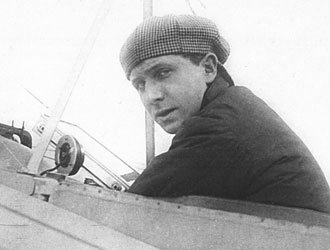
Geo Chavez

In 1910 the Touring Club Italiano, an Italian tourism and cultural foundation and the Corriere della Sera, one of the major Italian newspapers decided to arrange a new aeronautical challenge specifically for the recently invented airplanes. Only 7 years had passed since the Wright brothers’ first flight.
The flight path consisted in flying across the alps for the first time, taking off from Brig, in Switzerland, flying across the Simplon Pass, at 2000 m, and arriving in Milan with stops in Domodossola, Stresa and Varese in northern Italy. The whole path had to be completed within 24 hours.
The first person to show up to the competition was the 23 years old Georges Antoine “Geo” Chavez, a French aviator son of two important Peruvian emigrants who settled in Paris. Chavez had studied engineering in France and learnt to fly with Henry Farman, setting two altitude records in the summer of that same year. Four other aviators enrolled for the flight but eventually retired.
The endeavour was meant to happen in the summer of that year but ended up taking place at the end of September due to the impressive preparation required, which included building entirely from scratch an airfield and even an entire telephone line for emergencies going all the way from Switzerland to Italy. This delay probably affected the outcome of the event as the weather started worsening in late September
Finally on 23rd September 1910 the weather seemed acceptable enough for an attempt and Geo took off in his Bleriot XI with a 50 hp engine, the same aircraft type Louis Bleriot had used the year before to cross the English Channel.
Geo had already tried four days before but had to come back due to strong wings above 2000 m. This time he managed to continue, but the wind wasn’t much more merciful, and the turbulence shook the plane up and down along the whole route. After 42 horrific minutes he saw the meadows of Domodossola and approached for landing, but at the very last minute the wings, stressed and fatigued to the limit, ultimately failed and folded up around the fuselage at 20 m from the ground. Geo plummeted into the ground. He died for the shock in Domodossola four days later.

Build your Bleriot XI
You will find attached below the .pdf layouts of the 1/30 scale paper model of the Bleriot XI.
The required tools and materials consist in:
- Scissors or modelling knife
- Glue
- Ruler
- Barbeque bamboo skewer
- A4 Paper
- Printer
Almost any glue can be used on paper, however I do not recommend stick glue, which is often very weak. CA (cyanoacrylate, often called “super glue”) works relatively fine but leaves ugly stains (see photo below). Vinyl glue works decently, even better if diluted with some water and applied with a small brush. The ruler is useful to fold the paper in straight lines but isn’t strictly necessary. The barbeque skewer is meant to be used as wing spar.
To build the model first print the layout of normal A4 paper with the “actual size” option enabled. Paint the parts as desired and then cut them off the paper slicing along the thick black line.
The fuselage is built as shown in picture, except for the big square paper tabs on the tail tip, which are meant to be stuck together and support the rudder, all the others are meant to be glued on the inside, so not being visible once the part is completed.

The wings, the tailplane and the landing gear parts are reinforced on the leading edge with several layers of paper. Just fold the strips on each other and glue the last layer to prevent unfolding.

Glue the tailplane, the rudder and the main landing gear to the fuselage as shown.

add then the tail gear and the reinforcement strut of the main landing gear.

Finally poke a hole through the crosses on the fuselage and push the skewer through it, then glue the wings to the skewer and the fuselage, if desired add the propeller

Now you are done!
If you want to get a more realistic result you can make from scratch the bracing trusses on the top and bottom of the fuselage. Otherwise, you can add ballast to the nose and try to fly it as a paper plane.
