

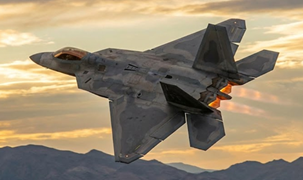

Fifth-generation aircraft are often discussed as a single “category,” but in practice they represent a broad set of engineering trade-offs. Beyond speed and agility, the defining theme is systems integration: shaping and materials for reduced detectability, advanced sensing, robust data processing, and high authority flight control. Two widely referenced examples—the F-22 and the Su-57—illustrate how different design priorities can lead to two distinct solutions within the same generation.
1) Low Observability: Geometry, Materials, and Thermal Management
F-22
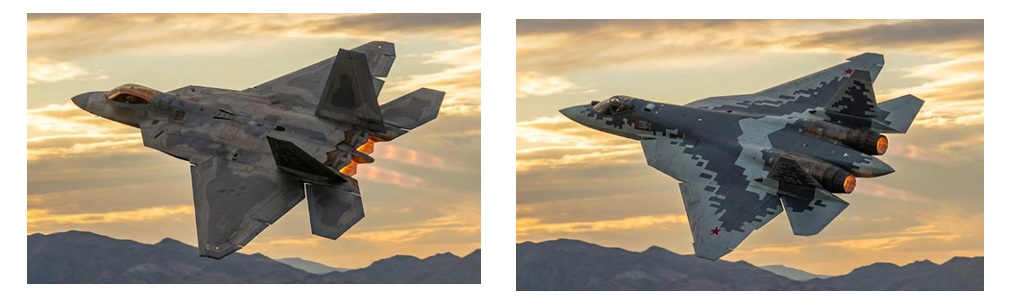
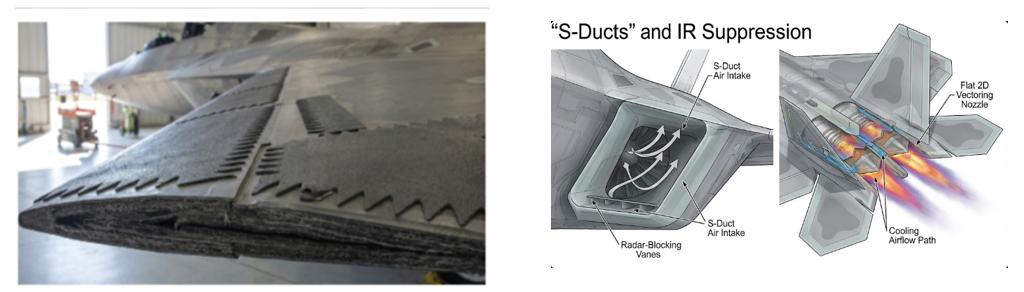
The F-22 emphasizes highly disciplined external shaping. Its overall geometry is designed to reduce the strength of reflections observed by external sensing systems, supported by extensive use of radar-absorbent materials (RAM) on the airframe. Intake and exhaust design choices also contribute to controlling visibility in other parts of the electromagnetic and infrared spectrum.
Su-57
The Su-57 takes a more balanced approach between reduced observability and aerodynamic freedom. It incorporates shaping measures and composite usage intended to reduce detectability, while preserving design flexibility that supports high-control flight regimes. In this philosophy, the aircraft aims for reduced rather than maximal observability reduction from every angle.
2) Propulsion and Sustained Supersonic Flight
A key performance theme in this class is sustained supersonic flight without relying heavily on fuel-intensive augmentation. This pushes engine and inlet design toward efficiency, thermal constraints, and stable airflow management across a wide flight envelope.
F-22
The F-22’s propulsion system is commonly associated with strong high-altitude performance and sustained supersonic capability. It also integrates thrust-vector control that supports precise pitch authority and stable maneuvering across varied conditions.
Su-57 The Su-57 is often highlighted for multi-axis thrust-vector control, supporting high agility and control authority, particularly in regimes where conventional aerodynamic surfaces can become less effective. The platform is also described as transitioning across engine configurations over its development lifecycle.
3) Sensors, Data Processing, and Situational Awareness
Modern aircraft capability is increasingly determined by how well a platform can sense, filter, fuse, and present information—while managing its own emissions and signatures.
F-22: AESA Radar and Emission Management
The F-22 is associated with an AESA radar architecture and emission-management concepts often discussed under “low probability of intercept” (LPI) design philosophy. Practically, this means the system focuses on effective sensing while reducing the chance of being easily characterized by external receivers.
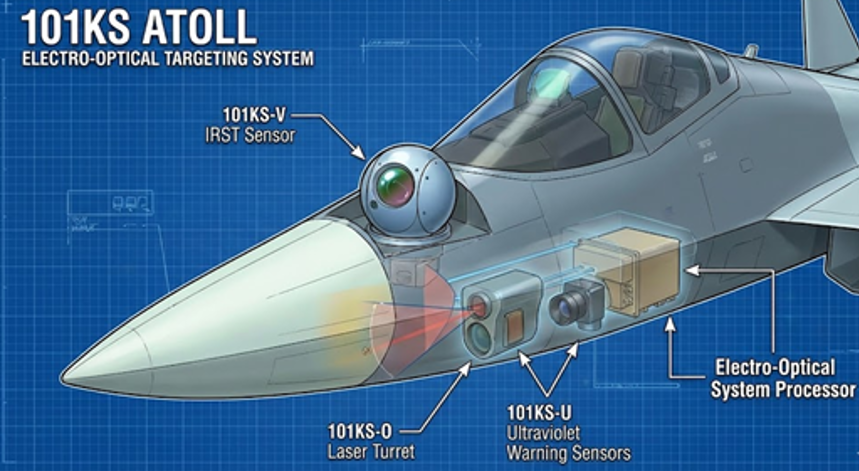
Su-57: Distributed Sensing and Passive Detection
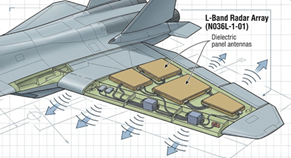
The Su-57 is described as using a distributed sensor approach, including elements such as:
- Wing-leading-edge L-band radar components, discussed as complementary sensing paths that leverage different frequency behavior than traditional radar bands.
Electro-optical / infrared search and track (IRST) suite, enabling passive detection and tracking without relying solely on active radar emissions.
4) Internal Bay Architecture and Structural Integration
A common design pattern for reduced-observability platforms is maintaining a clean external surface by using internal bay architecture. From an engineering perspective, this is not only about what is carried, but about:
- structural integration,
- center-of-gravity management,
- thermal constraints,
- door actuation complexity,
- and maintaining aerodynamic smoothness.
F-22
The F-22’s internal bay design reflects a tightly optimized integration approach, prioritizing packaging efficiency and low-observability constraints.
Su-57
The Su-57 features larger internal bay volume and tandem arrangements, which can provide greater flexibility in internal packaging and integration options—again from a structural/architectural standpoint.
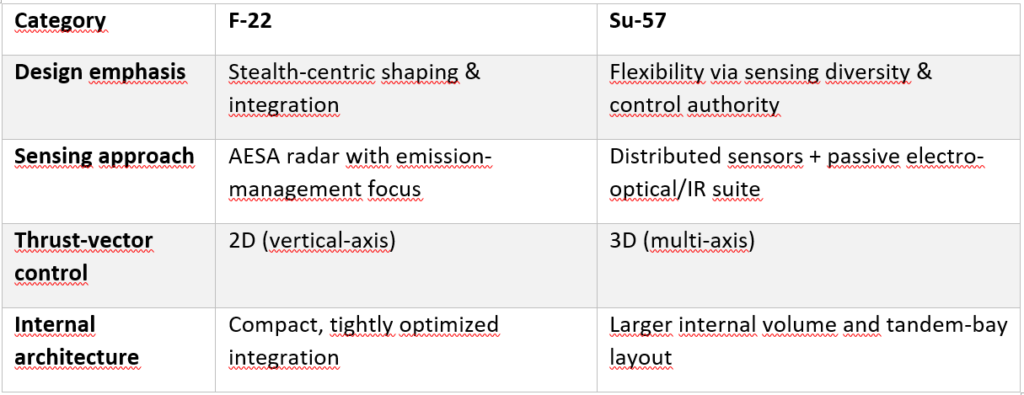
5) High-Level Comparison (Non-Operational Framing)
A comparison is most useful when it avoids “winner/loser” framing and instead highlights engineering priorities:
Conclusion: Two Engineering Trade-Off Maps
The F-22 and Su-57 demonstrate that “fifth-generation” is not a single blueprint, but a family of design choices. The F-22 reflects an approach built around tight external shaping discipline and highly integrated systems. The Su-57 reflects a route that emphasizes broader sensing architecture and high-control flight behavior, while still incorporating observability reduction measures.
From an engineering standpoint, the most valuable takeaway is not which platform is “better,” but how different constraints, materials, geometry, propulsion integration, sensing architecture, and control authority can be prioritized to produce two different, sophisticated solutions in the same generation.