



Categories: #DidYouKnow, Aerospace Articles
Introduction
Have you ever noticed the small vertical fins at the tips of modern aircraft wings? These structures are called winglets, and although they appear simple, they play a significant role in improving aircraft efficiency.
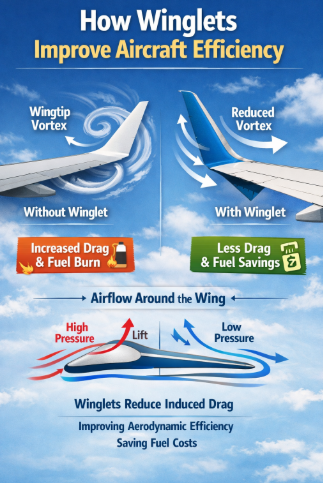
When an aircraft flies, the pressure difference between the lower and upper surfaces of the wing creates lift. However, this pressure difference also causes air to spill around the wingtip, forming swirling vortices. These vortices increase induced drag, forcing the aircraft to burn more fuel.
Winglets were introduced to reduce this effect. By altering the airflow around the wingtip, they improve aerodynamic efficiency and help airlines save millions in fuel costs.
Why Winglets Exist
Wingtip vortices are one of the main sources of drag during flight, especially at lower speeds such as takeoff and climb.
Winglets help reduce these vortices in several ways:
- Reducing induced drag: Winglets weaken the swirling air at the wingtip, which reduces drag.
- Improving fuel efficiency: Modern aircraft can save 4–7% fuel thanks to winglets.
- Increasing range: Less drag means aircraft can travel longer distances with the same amount of fuel.
- Lowering emissions: Reduced fuel burn also lowers carbon emissions.
Because of these advantages, winglets have become standard on many modern aircraft.
Types of Winglets
Winglets come in different shapes depending on the aircraft design and aerodynamic goals.
1. Blended Winglets
These are smooth, curved winglets that blend seamlessly into the wing. They are commonly seen on aircraft such as the Boeing 737NG.
2. Split Scimitar Winglets
An advanced version of blended winglets, these include an additional downward fin. They further improve fuel efficiency and aerodynamic performance.
3. Sharklets
Airbus uses the name Sharklets for its winglets on the A320 family. These devices provide fuel savings and increase payload capability.
4. Raked Wingtips
Some aircraft, such as the Boeing 787 and 777X, use long, swept wing extensions instead of vertical winglets. These designs achieve similar aerodynamic benefits.
How Much Difference Do They Make?
The impact of winglets may seem small at first glance, but the cumulative effect is enormous.
For example:
- A Boeing 737 equipped with winglets can save around 100,000 gallons of fuel per year.
- Airlines reduce operational costs and environmental impact simultaneously.
- Reduced wingtip vortices also slightly decrease wake turbulence.
These small aerodynamic improvements translate into massive economic and environmental benefits across the aviation industry.
A Small Change with Big Impact
Winglets are a perfect example of how small engineering innovations can lead to large improvements. By simply modifying the wingtip shape, engineers managed to reduce drag, improve efficiency, and make aviation more sustainable.
Today, winglets are not only functional but also iconic design elements that distinguish modern aircraft.
Next time you board a plane, take a look at the wingtip. That small upward fin is quietly saving fuel, reducing emissions, and making your flight more efficient.
Conclusion
Although winglets appear to be minor additions, they represent a major aerodynamic breakthrough in modern aviation. Their ability to reduce drag, improve fuel efficiency, and extend aircraft range has made them a standard feature on many commercial airplanes.
This small piece of engineering demonstrates how thoughtful design and aerodynamic understanding can significantly improve aircraft performance.