


As students, we become very familiar with what it means to fail: failing a test, getting stuck on a calculus exercise. What is often harder to understand is that failure is not the opposite of learning, but one of its main drivers. The more we fail and reflect on those mistakes, the more experience we gain and the less likely we are to repeat them. In a sense, the more we fail, the more we learn. Engineering is often perceived as the discipline of precision and control. Yet, some of its greatest advancements were born not from success, but from failure.
Laminar airfoils, developed within the NACA 6-series, were designed with a clear objective: to minimize aerodynamic drag by maintaining laminar flow over as much of the airfoil surface as possible. In ideal conditions, this approach proved highly effective, as laminar flow generates significantly less skin-friction drag than turbulent flow. However, the transition from theory to reality revealed a fundamental limitation. Even minor surface imperfections, contamination, or geometric deviations were enough to trigger an early transition to turbulence, cancelling the expected benefits. As a result, laminar airfoils turned out to be extremely sensitive and not robust, unable to deliver consistent performance under real operating conditions.
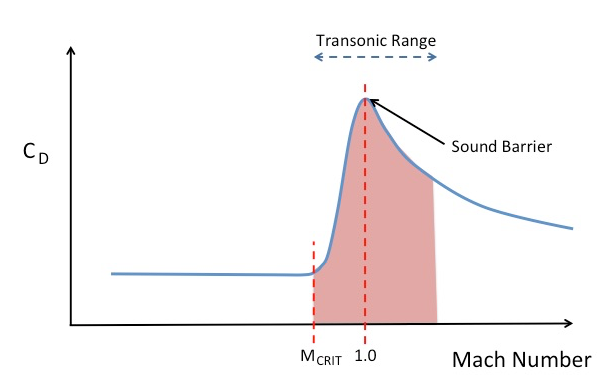
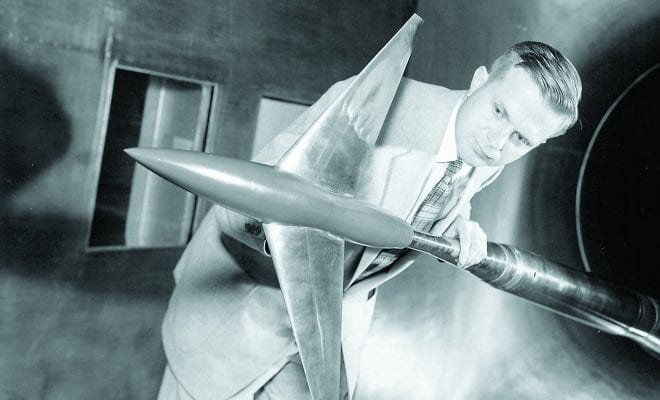
Another deep limitation emerged in the transonic regime: as the flow approaches Mach 1, shock waves form on the upper surface of the airfoil, leading to a sudden increase in drag known as drag divergence. Laminar airfoils, designed to delay transition rather than to manage compressibility effects, were not capable of controlling these shock phenomena. It became clear that the dominant physical constraint at higher speeds was the inevitable presence of shock waves. Instead of insisting on maintaining increasingly fragile ideal conditions, Richard Whitcomb (in the first picture) reframed the problem entirely.
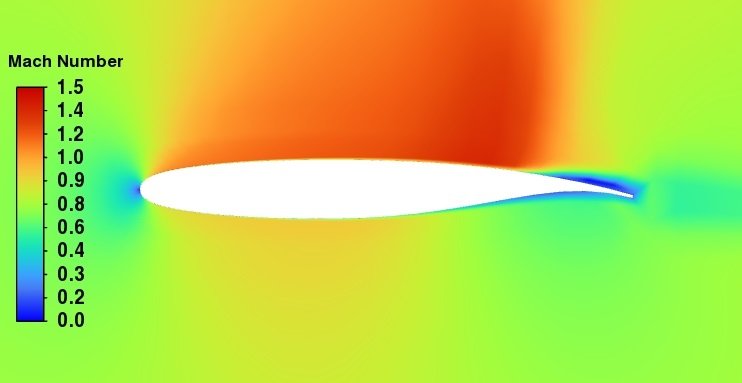
The objective therefore shifted from delaying transition or preserving laminar flow to reshaping the pressure distribution along the airfoil in order to control the formation and strength of the shock. This new perspective led to the development of the supercritical airfoil. Its geometry was fundamentally rethought: a flatter upper surface reduces peak flow acceleration and thus weakens the shock, while a more uniform pressure distribution allows the shock to move further downstream, closer to the trailing edge, where its impact is less severe. The shock is not eliminated, but it becomes weaker and more manageable, delaying drag divergence and improving efficiency in the transonic regime.
This shift, from laminar airfoils to supercritical design, makes this clear: progress, in this case, came from recognizing where the model and the efforts broke down and using that breakdown as a starting point. Richard Whitcomb did not avoid the limits of the transonic regime, he worked within them, reshaping the problem instead of forcing a solution. The same applies beyond aerodynamics: mistakes are not endpoints, but part of a process that, if observed carefully, leads to better decisions and deeper understanding. Each failure carries information and ignoring it only delays the learning it makes possible. This idea is well captured in the sentence:
“Take life with lightness: not as a form of superficiality, but as the capacity to glide above things, free from the weight of burdens upon the heart”