


1. The Take-off -Why I Joined EUROAVIA
A year ago, if you had told me that I would be building an aircraft for an international competition, presenting technical design reviews, or travelling to England to compete alongside engineering students from around the world, I probably would have laughed.
At the time, I had just started studying Aerospace Engineering at Rzeszów University of Technology. Apart from the occasional Ryanair flight, I had virtually no experience in aviation and no engineering background whatsoever. Most of my life had revolved around sports, with science being more of a personal interest than a serious pursuit.
Nevertheless, aerospace engineering seemed fascinating, and I decided to take a leap into the unknown.
During my first month at university, I also joined EUROAVIA Rzeszów. At the time, I saw it simply as an opportunity to meet like-minded people and learn more about aviation. What I didn’t realize then was just how many opportunities, projects, and international experiences would come with becoming a member.
My goal was simple: to find out what engineering was really about beyond lectures, textbooks, and exam halls.
2. SAE Aero Design: My First Real Engineering Project
So, what was it like joining a team of experienced yet surprisingly young aviation enthusiasts—people who had spent years building model aircraft, studying engineering, or simply immersing themselves in aviation?
To put it bluntly: incredibly intimidating.
For perhaps the first time in my life, I found myself in a room where I rarely knew the answers. As someone who had always been outspoken and confident in class, I suddenly had to take on a very different role—that of an observer. During my first meetings, discussions about aerodynamics, propulsion systems, structural design, and competition regulations often went completely over my head. It felt as if everyone else spoke a language I had only just begun learning.
The competition itself was SAE Aero Design Micro Class, an international aircraft design competition that challenges student teams to develop, build, and fly a radio-controlled aircraft optimized for a specific mission. Our aircraft was constructed primarily from balsa wood reinforced with carbon-fibre elements, providing an excellent balance between strength and weight. Through the project, I learned the fundamentals of model aircraft construction, from structural design considerations to building techniques and material selection.
The mission requirements were deceptively simple but created a fascinating engineering challenge. The aircraft had to take off within a very short distance while carrying as much water payload as possible. At the same time, teams were rewarded for minimizing the aircraft’s wingspan, forcing us to carefully balance lift, weight, stability, and aerodynamic efficiency. Like many engineering problems, success depended on finding the right compromise between competing requirements rather than maximizing a single parameter.
My first task was somewhat unexpected. Rather than working directly on the aircraft, I was asked to prepare the structure of the technical presentation for SAE Aero Design, a competition in which the team had participated for many years. I was given this responsibility because of my experience with public speaking and my strong command of English—proof that skills that seem unrelated to engineering can often become surprisingly valuable within it.
The task turned out to be one of the best introductions to engineering I could have asked for. In order to explain the aircraft, I first had to understand it. I spent countless hours talking with team members about the mission requirements, design decisions, calculations, propulsion system, and overall development process. Through these conversations, I not only learned how the aircraft worked but also got to know the people behind it.
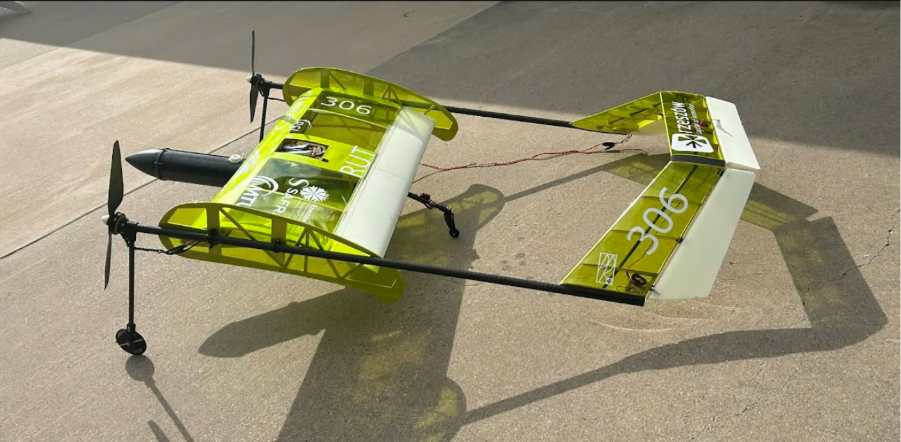
As the months passed, I had the opportunity to help with the construction of the aircraft, observe the technical report-writing process, and see firsthand how much work goes into preparing for an international engineering competition. It certainly wasn’t easy. There were plenty of late nights, countless revisions, moments of uncertainty, and many occasions when none of us were entirely sure whether we were on the right track. Yet that challenge was precisely what made the experience so rewarding.
All of that effort culminated in March 2026, when I had the privilege of leading our technical presentation in front of a panel of experienced industry judges. The result exceeded all expectations: our presentation placed 5th, the team’s best result in years; our technical report achieved 2nd place, the highest in the team’s history; and our mission performance finished 4th, just missing the podium.
While it was tempting to focus on how close we came to a medal, what I felt most strongly was pride—pride in myself, pride in the team, and pride in how far we had come. More importantly, the experience ignited something in me. For the first time, engineering stopped being a collection of university subjects and became something tangible, challenging, and deeply rewarding. Rather than being disappointed by what we had narrowly missed, I left motivated by what we could achieve next. However, competitions were only one part of my first year in EUROAVIA.
3. More Than Aircraft
While competitions were undoubtedly some of the highlights of my first year, they were far from the only opportunities that EUROAVIA opened up for me.
During the spring semester, I attended my first aviation conference in Mielec, participated in a debate on the future of drones, and took part in my first hackathon in Stalowa Wola. Looking back, these experiences taught me lessons that were very different from those learned while designing and building aircraft.
The aviation conference in Mielec was particularly inspiring. For the first time, I found myself surrounded by industry experts, engineers, researchers, and aviation professionals discussing the future of flight. Listening to their perspectives on emerging technologies, sustainability, unmanned systems, and the challenges facing modern aviation made me realize just how vast and dynamic the aerospace industry truly is. It reinforced my passion for aviation and gave me a glimpse of the exciting possibilities that lie ahead.
The hackathon in Stalowa Wola was an entirely different challenge. Unlike a university assignment, there was no clearly defined solution and no step-by-step procedure to follow. Our team had to identify a problem, understand the needs of potential users, generate ideas, and transform them into a viable product—all under significant time pressure.
It was one of the most demanding experiences of the year, but also one of the most rewarding. More than anything, it taught me the importance of creativity in engineering. Technical knowledge is essential, but the ability to think creatively, adapt quickly, and design solutions around real user needs is equally important. It is a skill that no textbook can fully teach, yet one that every engineer should strive to develop.
Experiences like these showed me that engineering is not just about calculations, reports, or technical drawings. It is also about communication, innovation, teamwork, and understanding the people for whom we design solutions.
4. BMFA Payload Challenge: From Observer to Competitor
By the time preparations for the BMFA Payload Challenge began, I felt far more confident than I had during my first months in EUROAVIA. While there was still plenty to learn, I was
no longer simply observing engineering projects from the sidelines—I was actively contributing to one.
Unlike SAE Aero Design, this time I had the opportunity to travel with the team and experience the competition firsthand. For me, that alone was incredibly exciting. What had started only months earlier as curiosity about aviation and engineering had now taken me all the way to England to represent my university and compete against teams from across Europe.
The project itself introduced me to several fascinating engineering solutions. Our aircraft was fully laminated using carbon-fibre composites, giving it an excellent strength-to-weight ratio. To maximize performance, the aircraft utilized a launch dolly rather than conventional landing gear. Once airborne, the dolly was left behind, eliminating unnecessary drag during flight. The aircraft also featured folding propeller blades which would fold back during the belly landing, preventing damage upon touchdown.
At first glance, many of these solutions seemed unusual. However, working on the project taught me that engineering is often about challenging assumptions and finding unconventional ways to solve problems. The best solution is not always the most obvious one.
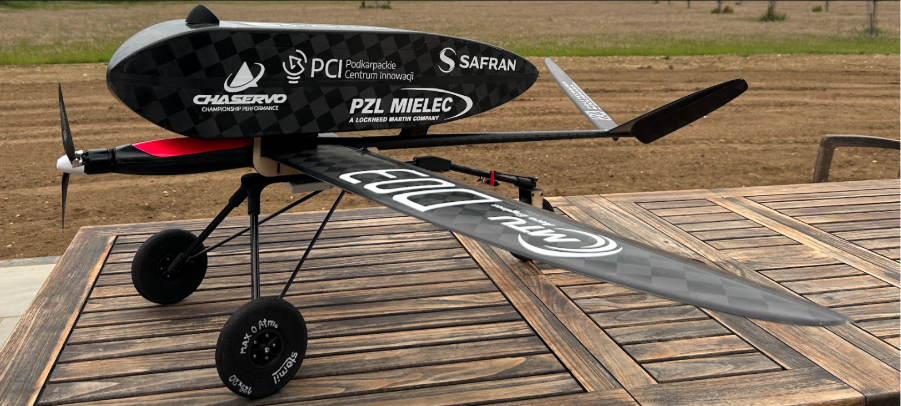
The competition mission was deceptively simple: carry a one-kilogram wooden payload and complete as many laps as possible within six minutes using a competition-mandated battery. Yet behind that simple objective lay countless design decisions, trade-offs, calculations, and hours of testing.
Being present at the competition was an unforgettable experience. Meeting other teams, seeing their aircraft, and exchanging ideas with fellow students gave me a new appreciation for the creativity and ingenuity that exists within student engineering projects.
However, nothing compared to the tension of the competition flights themselves.
I still remember standing on the flight line as our pilot took control of the aircraft. Months of work were suddenly condensed into six minutes. Watching the aircraft disappear into the distance, lap after lap, while having absolutely no control over the outcome was one of the most nerve-racking experiences of my life. Those six minutes felt significantly longer.
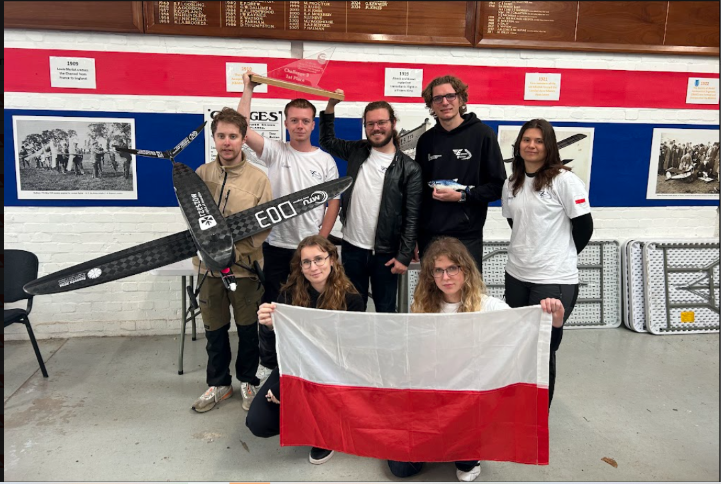
When the results were finally announced, months of hard work, testing, and preparation had paid off. To our amazement, the team secured first place in every category : the technical report, the technical presentation, and the flight mission itself.
Winning was an incredible moment, but what I remember most is the journey that led there. The competition showed me how much I had grown since joining EUROAVIA only a few months earlier. More importantly, it reinforced a lesson I had been learning throughout the year: engineering is rarely a solo effort. Success is built through teamwork, trust, perseverance, and the willingness to keep improving, even when the solution is not immediately obvious.
Looking Back After One Year
Looking back, my first year in EUROAVIA was one of the most challenging experiences I have ever taken on.
Balancing university coursework, sports, part-time work, and the demands of club projects was far from easy. There were plenty of late nights, early mornings, stressful deadlines, and moments when I questioned whether I had taken on too much. To put it mildly, it was challenging.
Yet despite all of that, I would do it again without hesitation.
Looking back, one of the things I appreciate most is how willing people were to help. No matter how basic my questions seemed, someone was always willing to explain a concept,
review an idea, or share their experience. Whatever success I achieved this year was only possible because of the support, knowledge, and encouragement of the people around me.
When I first joined EUROAVIA, I knew almost nothing about aviation and even less about engineering. I certainly never imagined that within a single year I would help prepare technical presentations, work on competition aircraft, attend aviation conferences, participate in a hackathon, travel internationally, and stand on the flight line watching an aircraft built by my teammates compete against some of the best student teams around.
So why did I decide to write this blog?
Partly because I wanted to share my experience, but mostly because I hope it reaches someone who may be standing where I was only a year ago. Maybe you’re considering joining a new club, starting a new degree, or entering a field where it feels like everyone else is already ahead of you.
If there is one lesson I have learned this year, it is that being behind is not a reason not to start.
You do not need years of experience. You do not need to know all the answers. You do not need to be the smartest person in the room. What matters most is curiosity, a willingness to learn, and the courage to put yourself in situations where you might fail.
In fact, my biggest piece of advice is simple: do the things that scare you.
Some of the most rewarding experiences of my first year began with uncertainty. Joining EUROAVIA was intimidating. Presenting in front of judges was intimidating. Travelling abroad to compete was intimidating. Yet each of those experiences taught me far more than staying within my comfort zone ever could.
For any first-year engineering student, I would strongly encourage joining an engineering organization or project team if the opportunity exists. The classroom provides the foundations, but projects, competitions, conferences, and teamwork are where those foundations truly come to life.
One year ago, I joined EUROAVIA hoping to learn more about aviation. Instead, I found opportunities to travel internationally, work on real engineering projects, and meet people who share the same passion for aerospace. Most importantly, I discovered a field that genuinely excites me and challenges me to keep improving.
I still have a lot to learn, but after SAE Aero Design, BMFA, conferences, hackathons, and everything in between, I can confidently say that walking into my first EUROAVIA meeting was one of the best decisions I made during my first year at university.