


Introduction
Imagine that a mechanic accidentally drops a tool onto an aircraft wing during maintenance.
The impact is small. There is no visible crack, no hole, and no dramatic sign of damage. After a quick look, everything appears normal.
But what if the real damage is hidden beneath the surface?
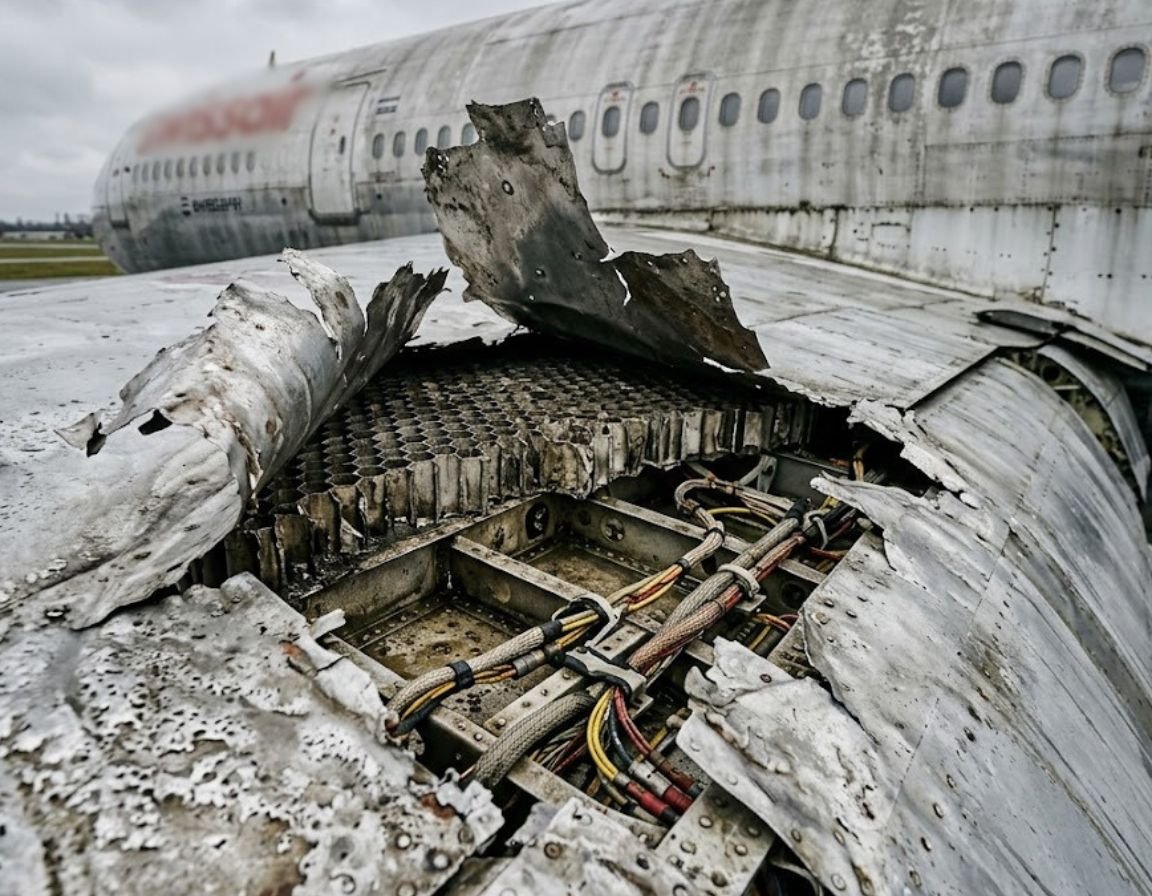
This is one of the challenges associated with modern composite aircraft structures. Unlike traditional metal components, composite materials can suffer significant internal damage while showing only minor, or sometimes no visible signs on the outside. Engineers refer to this phenomenon as Barely Visible Impact Damage (BVID). Despite its harmless appearance, BVID is considered one of the most important damage mechanisms in modern aerospace structures.
What Is BVID?
Modern aircraft increasingly rely on carbon-fibre reinforced polymer (CFRP) composites because they are lightweight, strong, and resistant to corrosion.
However, composites behave differently from metals when subjected to impact.
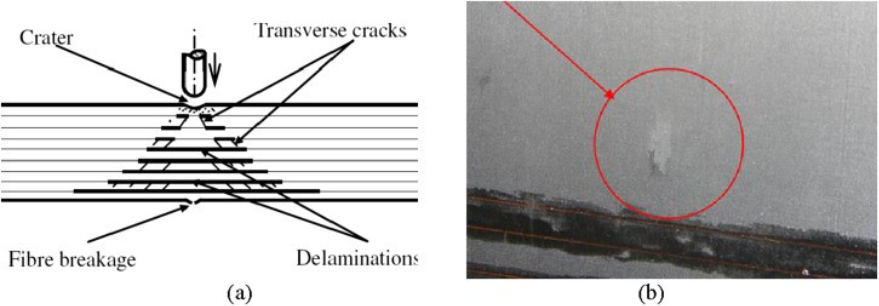
When an aluminium panel is damaged, the dent is usually easy to spot. In composite structures, a low-energy impact may leave only a small surface mark while creating extensive internal damage. Layers inside the material can separate from each other, a process known as delamination. Matrix cracks may also form beneath the surface.
As a result, the visible damage may be much smaller than the actual damaged area hidden inside the structure.
How Does It Happen?
BVID is usually caused by relatively low-energy impacts, such as maintenance tools accidentally dropped onto an aircraft surface, hail strikes, runway debris, or ground handling incidents. Although these events may seem insignificant, they can generate enough force to damage the internal layers of a composite laminate. Because the outer surface often remains almost intact, the problem can easily go unnoticed.
Why Is It Dangerous?
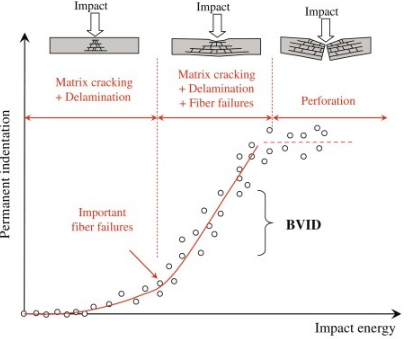
The main concern is not the dent itself.
Internal delamination can reduce the residual strength of the structure. Under compressive loads experienced during flight, damaged areas may become more susceptible to buckling or further crack growth. In severe cases, an undetected impact can compromise structural integrity long before any obvious external signs appear.
This is why BVID has become a major focus of aerospace research and maintenance programs.
In fact, studies have identified impact damage detection as one of the most important needs in structural health monitoring for modern aircraft.
Finding Damage That Isn’t Visible
Since visual inspections are often insufficient, engineers use non-destructive testing (NDT) methods to detect hidden damage. Common techniques include ultrasonic inspection, X-ray imaging, thermography, and structural health monitoring systems. These methods allow engineers to examine composite structures without causing further damage. As the use of composite materials in modern aircraft continues to grow, reliable inspection techniques are becoming increasingly important.
Looking Ahead
Researchers are currently developing smarter ways to detect BVID.
Future aircraft may include embedded sensors capable of continuously monitoring structural health and identifying damage before it becomes a safety concern. Some concepts even explore self-sensing composite materials that can detect changes within their own structure.
While these technologies are still evolving, they highlight an important reality of modern aerospace engineering: sometimes the most dangerous damage is the damage we cannot see.
Conclusion
Barely Visible Impact Damage reminds us that what appears minor on the surface can hide serious structural damage beneath. As composite materials become increasingly common in modern aircraft, advanced inspection techniques and continuous structural health monitoring will play a vital role in maintaining safety. In aerospace engineering, seeing the damage is no longer enough understanding what lies beneath is just as important.
References
- Detecting Barely Visible Impact Damage Detection on Aircraft Composite Structures, Composite Structures (2009).
- Reconstruction of Barely Visible Impact Damage in Composite Structures Based on Non-Destructive Evaluation Results, Sensors (2019).
- Barely Visible Impact Damage in Scaled Composite Laminates: Experiments and Numerical Simulations.
- Modelling Low Velocity Impact Induced Damage in Composite Laminates, Springer (2017).