


During the height of the Cold War, the iconic SR-71 Blackbird spy plane—cruising at an altitude of approximately 85,000 feet and speeds of Mach 3.2 (more than three times the speed of sound)—was hailed as one of the most extraordinary engineering feats in aviation history. Yet, the most peculiar aspect of this supersonic legend—in stark contrast to the flawlessness it displayed in the sky—was its tendency to constantly drip jet fuel while waiting on the runway before takeoff. Although this initially appeared to be a serious technical malfunction or a manufacturing defect, it was actually the result of an ingenious engineering solution designed to withstand the extreme physical conditions the aircraft would encounter once airborne.
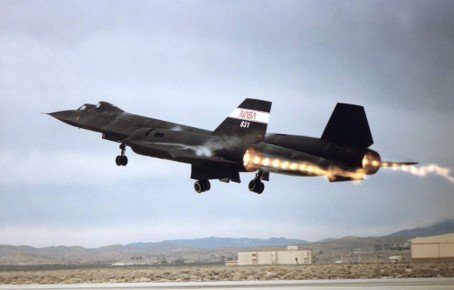
A Lockheed SR-71 Blackbird preparing for takeoff on the runway. The aircraft was designed to leak while on the ground due to expansion gaps in its fuselage panels.
Thermal Expansion and Titanium Airframe Design
When flying at speeds around Mach 3, the SR-71 Blackbird was subjected to intense aerodynamic heating caused by friction between the air and the aircraft’s surface. Temperatures in critical areas, such as the nose and wing edges, soared to between 300°C and 330°C (over 600°F). Since standard aluminum structures would melt and deform at such extreme temperatures, the majority of the aircraft’s airframe was constructed from heat-resistant titanium alloys. However, titanium’s coefficient of expansion at high temperatures posed a major challenge for engineers.
As the aircraft cruised at high speeds, the fuselage panels would expand and lengthen by several centimeters; in fact, the aircraft’s total length would increase by 3 to 4 inches (approximately 7–10 cm) compared to its cold state. Had the panels been tightly fastened together on the ground, the expansion occurring at Mach 3 speeds would have caused the fuselage to buckle, crack, or disintegrate. Reaching speeds exceeding Mach 3 at cruising altitude, the SR-71 achieved a perfectly sealed structure as the panels expanded due to aerodynamic heating.
Fuel Tanks and the Sealing Problem
To save weight, the SR-71’s fuel tanks were designed not as separate internal reservoirs, but directly as the inner surfaces of the aircraft’s outer fuselage panels (integral tanks). Because expansion joints and gaps were intentionally left between the fuselage panels to accommodate thermal expansion, the fuel tanks were not fully sealed while on the ground. Standard sealing gaskets could not be used either, as they would have melted at the extreme temperatures generated during flight.
Consequently, while the SR-71 waited on the runway, a specially developed jet fuel known as JP-7 would constantly drip from the fuel tanks. Aerial refueling from a KC-135Q tanker aircraft took place shortly after takeoff, once the engines had warmed up and the fuselage panels had expanded to seal the structure. Special Fuel Formula: JP-7
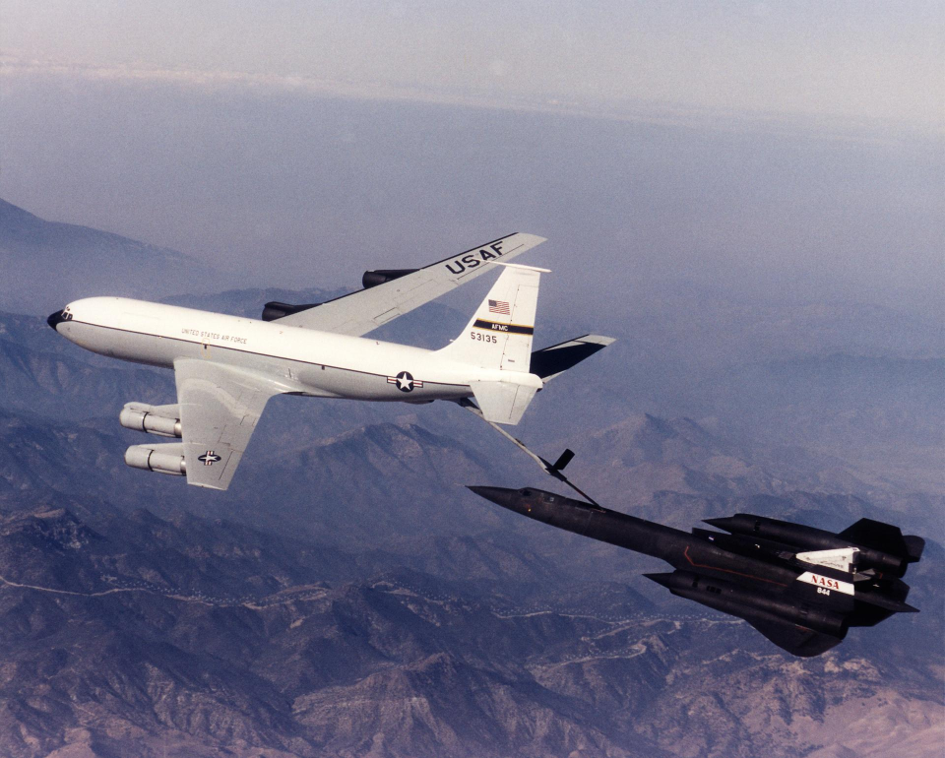
In-flight refueling with a KC-135Q.
The greatest danger posed by an aircraft that constantly dripped fuel while on the ground was the risk of fire. However, Skunk Works engineers solved this problem with a safe chemical formula: JP-7 fuel, developed specifically for the SR-71, possessed extremely low volatility and a high flash point.
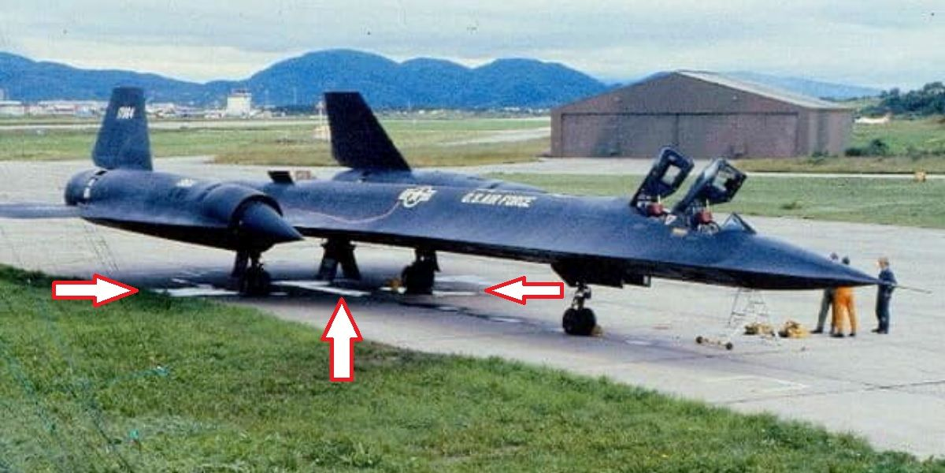
An SR-71 dripping JP-7 fuel while on the ground.
JP-7 was chemically so stable and difficult to ignite that it would not catch fire even if a lit match were dropped into a puddle of it on the ground. To ignite the fuel inside the engines, a special chemical additive called triethylborane (TEB)—which spontaneously ignites upon contact with air—had to be injected into the combustion chambers.
Takeoff and In-Flight Transformation
A typical SR-71 mission consisted of the following stages:
Takeoff with a Partial Fuel Load: To avoid excessive weight on the runway and prevent unnecessary fuel leakage while on the ground, the aircraft took off at a lighter weight rather than with fully filled tanks.
Warm-up and Perfect Sealing: Shortly after takeoff, the aircraft accelerated and broke the sound barrier; as the airframe heated up, the titanium panels expanded and locked tightly together, completely halting any leaks. Aerial Refueling: Once the airframe had sealed, the SR-71 would rendezvous with a specially modified KC-135Q tanker aircraft to fill its fuel tanks to capacity before commencing its primary high-altitude, high-speed mission. The SR-71 Blackbird: An example of how the laws of physics and thermal expansion were transformed from obstacles into integral elements of the design.
Conclusion
The Lockheed SR-71 Blackbird stands as the ultimate proof of how a physical constraint—which might otherwise be viewed as an engineering “flaw”—can be turned into a revolutionary advantage through the right approach. That mass of titanium, helplessly dripping fuel while sitting on the runway…
References
Rich, Ben R. & Janos, Leo (1994). Skunk Works: A Personal Memoir of My Years at Lockheed. Little, Brown and Company.
NASA Armstrong Flight Research Center (Dryden Photo Collection).