

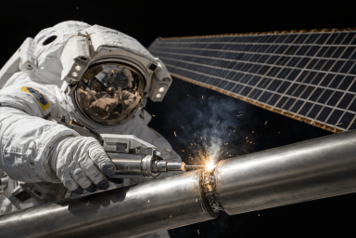

Terrestrial manufacturing requires extreme energy—from oxyacetylene flames, electric arcs, or hydraulic force—to permanently join structural metals. On Earth, metals never fuse upon simple contact. In the vacuum of space, however, two clean, flat metallic surfaces can instantly fuse into one without heat or sparks. Known as cold welding, this reaction has evolved from a laboratory curiosity into a critical aerospace hazard.
An Invisible Shield: Natural Oxide Layers
To understand cold welding in space, one must examine why metals remain separate on Earth. Earth’s atmosphere contains roughly 21% molecular oxygen, alongside moisture and trace hydrocarbons. When a reactive metal is exposed to this environment, it rapidly undergoes passivation. Within milliseconds, a stable dielectric oxide layer—such as alumina (Al₂O₃), titania (TiO₂), or chromium oxide (Cr₂O₃)—forms on the metal’s outer surface, measuring only 2 to 10 nanometers thick.
This microscopic oxide layer traps ambient moisture and volatile organic compounds. Consequently, under terrestrial conditions, contacting metal pieces cannot meet at the atomic level. Instead, microscopic surface irregularities—peaks and valleys—touch only at isolated points insulated by chemically inert barriers. Since conduction electron clouds remain separate, metallic bonds cannot form.
Vacuum Environment: The Disappearance of Atomic Boundaries
When a spacecraft enters low Earth orbit (LEO) or interplanetary space, ambient pressure drops to between 10⁻¹² and 10⁻⁹ Torr, triggering three critical changes:
- Absence of Oxygen: The near-total lack of oxygen molecules prevents repairing or regenerating damaged oxide layers.
- Desorption and Outgassing: Moisture, atmospheric gases, and organic surface films evaporate instantly in space vacuum.
- Tribological Stripping: Acoustic vibrations and mechanical movements cause bare surfaces to rub, detaching brittle native oxide layers at contact points.
Once these passivation layers are stripped—without oxygen to regenerate them—bare metal atoms with unfilled valence orbitals touch directly. In quantum mechanics, contacting atoms cannot distinguish whether they belong to separate objects or share the same crystal lattice. Displaced valence electrons move freely across the interface, forming a continuous metallic bond. The mechanical boundary disappears, leaving a single, unified crystal grain.
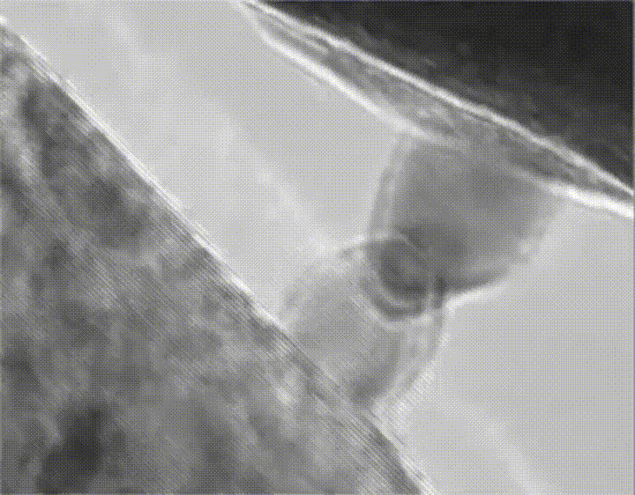
In situ observation of the cold-welding process between metallic nanowires using Transmission Electron Microscopy (TEM). When two pristine, oxide-free surfaces come into contact within a vacuum environment, the atoms rearrange themselves—without any external heat input—to form a single, continuous crystal lattice, effectively eliminating the interface boundary entirely.
Lattice geometry dictates susceptibility to cold welding. Face-Centered Cubic (FCC) metals—such as gold, silver, copper, and aluminum—feature numerous slip planes, low yield strength, and high atomic ductility, making them prone to spontaneous bonding and grain growth. In contrast, Hexagonal Close-Packed (HCP) metals, such as titanium and cobalt, have limited slip systems at ambient temperatures and resist adhesive bonding far more effectively.
The Galileo Anomaly: A Costly Lesson
The theoretical risk of cold welding became reality in April 1991, during NASA’s Galileo mission to Jupiter. Following a gravity-assist maneuver, mission control commanded the spacecraft to deploy its 4.8-meter umbrella-like High-Gain Antenna (HGA). Comprising 18 graphite-epoxy ribs supported by structural pins, the antenna was designed to unfurl within minutes. However, the deployment motors stalled; only a few ribs opened, leaving the antenna completely jammed.
JPL telemetry analysis revealed that dry lubricant coatings on the structural pins had worn away from fretting wear caused by transit and launch vibrations. Exposed to space vacuum, the bare titanium pins cold-welded directly to their sockets. Despite repeated thermal cycling and commands sent across millions of kilometers, the atomic bonds remained intact. Mission scientists were forced to transmit all scientific data via a backup low-gain antenna at significantly slower transmission rates.
Space Tribology Solutions: Solid Films and Ceramics
The Galileo failure permanently altered the design philosophy for spacecraft mechanisms. Since standard liquid lubricants outgas in space and condense onto sensitive optics, engineers developed advanced solid-state tribological solutions:
Lamellar Solid Lubricants: Molybdenum disulfide (MoS₂) and tungsten disulfide (WS₂) consist of anisotropic hexagonal crystal layers held by weak van der Waals forces. Applied as thin films onto sliding components, these layers glide easily, preventing direct metallic contact.
Diamond-Like Carbon (DLC) and Ceramic Coatings: Coating surfaces with hard amorphous carbon or titanium nitride (TiN) creates chemically inert, non-metallic interfaces that cannot form metallic bonds.
Hybrid Ceramic Bearings: Combining metallic bearing races with sintered silicon nitride (Si₃N₄) rolling elements prevents contact between identical metallic lattices, eliminating the risk of cold welding.
Conclusion
The phenomenon of cold welding reveals that the vacuum of space is not merely an empty geometry; rather, it is a highly potent and challenging physical environment that fundamentally alters material behavior. A bond that would require a significant input of heat to form within Earth’s atmosphere occurs spontaneously once that atmospheric blanket is removed. Aerospace engineers have transformed this dangerous atomic trap into a fundamental design principle for deep-space exploration by employing solid-film lubrication methods and ceramic interfaces.
References
- NASA Jet Propulsion Laboratory (1995). Galileo High Gain Antenna Deployment Anomaly Analysis. NASA NTRS.
- European Space Tribology Laboratory (ESTL / ESA) (2014). Space Tribology Handbook: Guidelines on Mechanisms and Adhesion Prevention.
- Bowden, F. P., & Tabor, D. (2001). The Friction and Lubrication of Solids. Oxford University Press.
- ASM International (2017). ASM Handbook, Volume 18: Friction, Lubrication, and Wear Technology.
- https://nhsjs.com/2026/cold-welding-in-space-limitations-and-opportunities/