



Last week I spent a couple lunch breaks watching the Air Cargo Challenge streamed live from Stuttgart. For the first time a team from my university, the AirOne team, had taken part to that competition and I felt quite proud for that. Three years ago, when I was still an active part of it our local group was much smaller, the support from the university seemed unreachable and all of that seemed impossible.
I also thought that maybe the story of such humble early steps might be useful for some other group which might someday face the same challenges.
An old story…
March 2023, the winter exam period was finally over. I was the secretary of my local group and together with the rest of the board we decided to begin some sort of preparation for the Air Cargo Challenge, in an attempt to participate to the 2024 edition. Registrations would open only in Autumn but it was clear that we had to take some form of action before that moment. We didn’t have enough members to be acknowledged by university and this led to two big problems: we had no access to any fundings or support from our university and we didn’t have enough people ourselves from which to recruit enough members for a proper technical team.
In other words we had to start small. Very small.
At least one problem could still be faced: it was imperative that at least the few people we could involve could get a chance to make experience in designing, building and possibly flying a model plane, because the resources you have do not matter if there’s no one in your team with hands on experience on what you need to do, especially when the schedules are tight and you have to figure out early and well what difficulties and costs a certain design choice would imply.
For this reason we decided to give up on asking the university for support and start a technical event completely on our own about rc modelling.
We were lucky enough to find an airfield nearby that gave us access to a small hut for construction and repair and the runway for test flights (prior coordination with the pilots). In exchange we paid a small rent and helped them advertising their flight school.
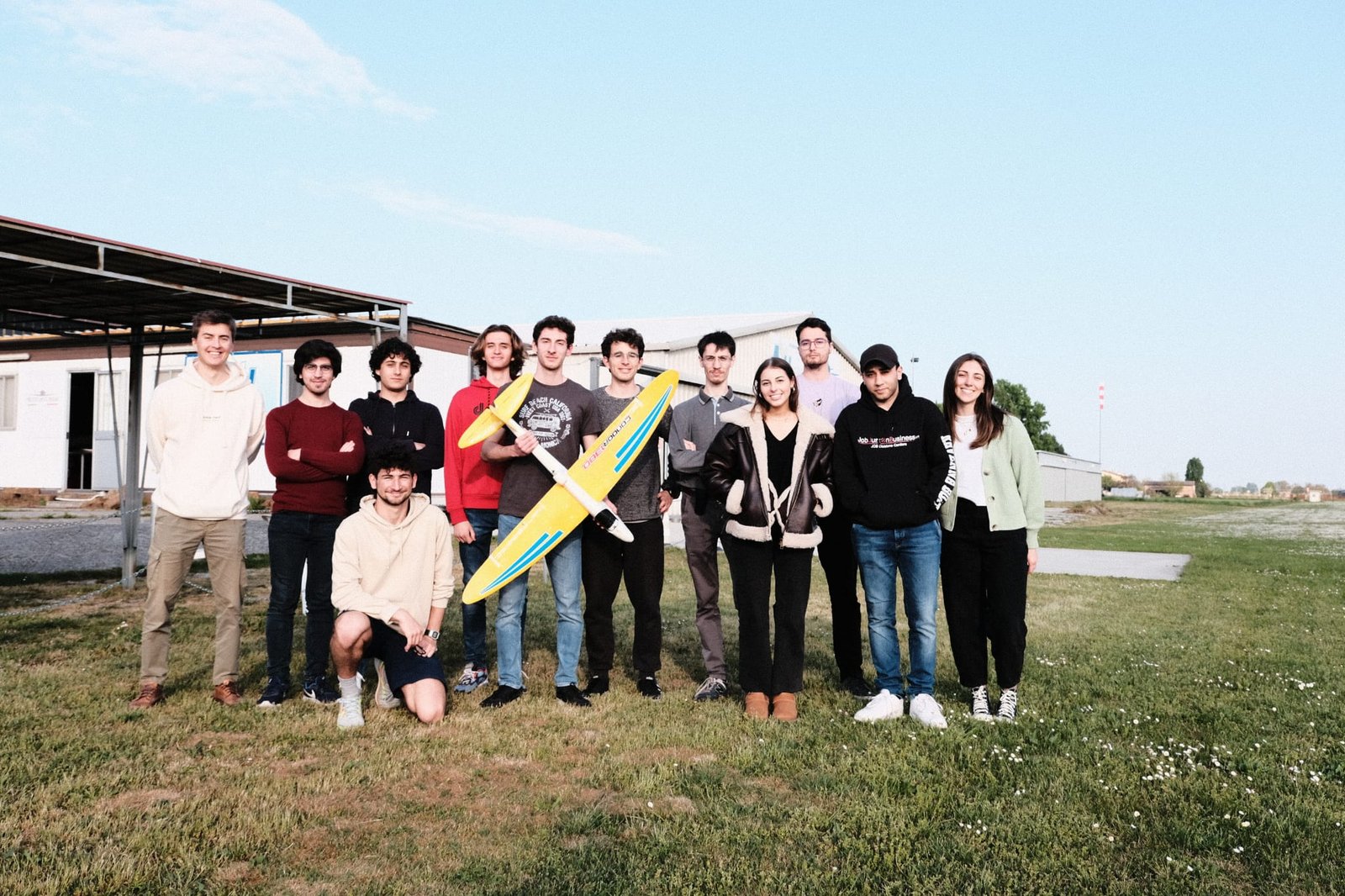
We opened participation to all our members and ended up with a team of a dozen. Due to the small numbers we didn’t even need a real selection process. All was expected was a small contribution to buy basic tools and materials. We called this project “Flight Club”.
We started in April and for three month we have been meeting once a week after the university lessons. The whole workshop consisted in designing and building from scratch a model aircraft and it was divided into three main parts: Theoretical sessions, construction and test flights.
The theoretical sessions were dedicated to conceptual and preliminary design but also included the fundamentals of flight mechanics and structural design, involving both the classical engineering notions and some rc rules of thumb with their proof, since they often come in handy when quickly evaluating the feasibility of a certain design choice.
The next step should have been detail design, however due to the little time available only a few of the members have been involved in the design of all the single parts. All the choices have in any case been explained and discussed later with everyone.
The final layout was a high wing single motor electric trainer. Mostly made of Depron foam, with wooden spars and longerons reinforced by several poplar plywood doublers on the most stressed parts.
The parts were simple on purpose, with a box-shaped fuselage, a plain untapered wing and a simple taildragger landing gear made of a bent aluminium plate.
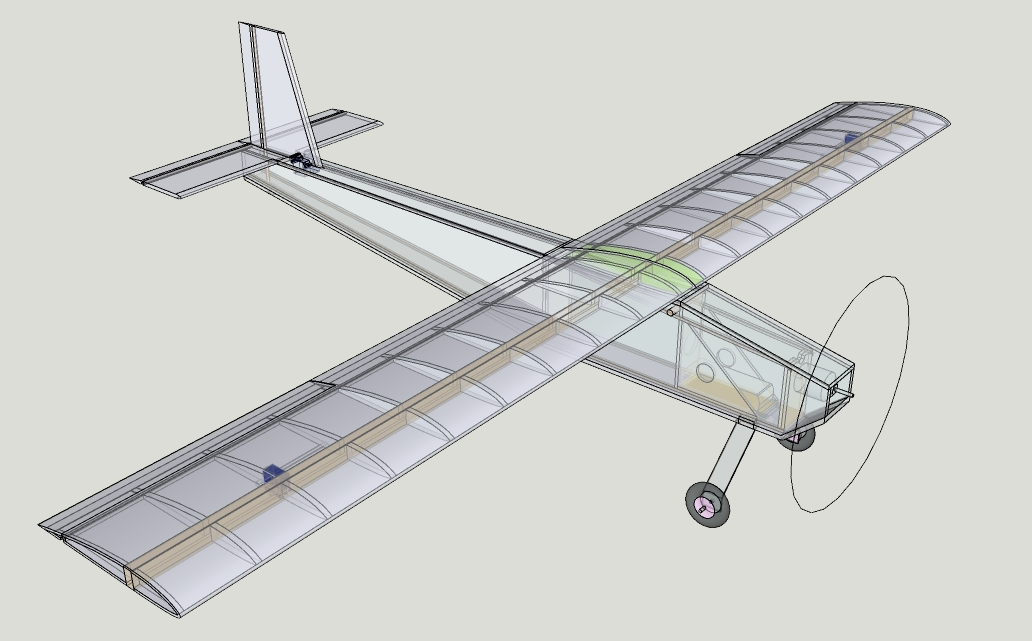
The beginning of the construction phase consisted in cutting the various foam and wooden parts and gluing them together, a very simple step that often turns out critical when practice is lacking.
The most common issue after the basic “measure twice, cut once principle” turned out to be the fact that even a slight lack of accuracy can make two parts almost impossible to join. Leading to a very beautiful learning curve among the participants, who learned to either be more precise, to check alignments at the right time or, when needed, to redesign a joint for more construction tolerance.
Another interesting learning area was woodworking, because although wood is quite deprecated nowadays in aerospace for most academic or industrial projects it remains a very practical material for aeromodelling and also has a lot to teach on its own. Similarly to composites, for example, it is anisotropic, has a good strength to weight ratio, doesn’t really tolerate concentrated loads (unless reinforced accordingly) and is bonded in a similar fashion. At the same time it is also much cheaper, available and easier to work with. Plus being it much softer it allows for more tolerance in joints and is easy to sand and file, thus making it the perfect entry-level load-bearing material for aeronautical structures. The last part of the construction consisted in the installation of the control surfaces, the electronics and the power plant.
Alongside the construction we took some chances to experience rc flight. We had many breaks due the glue drying time that could be exploited by teaching the participants the control basics by means of a free pc flight simulator using our radio transmitter as a joystick. At one point we moved on to real flight lessons using an old basic rc plane and it was interesting for the members to link all the various design parameters to the in-flight behaviour of the plane. Variables like tail volume, wing loading and static thrust-to-weight ratio appear to be only numbers until you have some hands-on experience on what they do mean for the pilot and it is easy, prior to that experience, to just attempt to design a plane uniquely focused on performance with little consideration on what the handling would be.
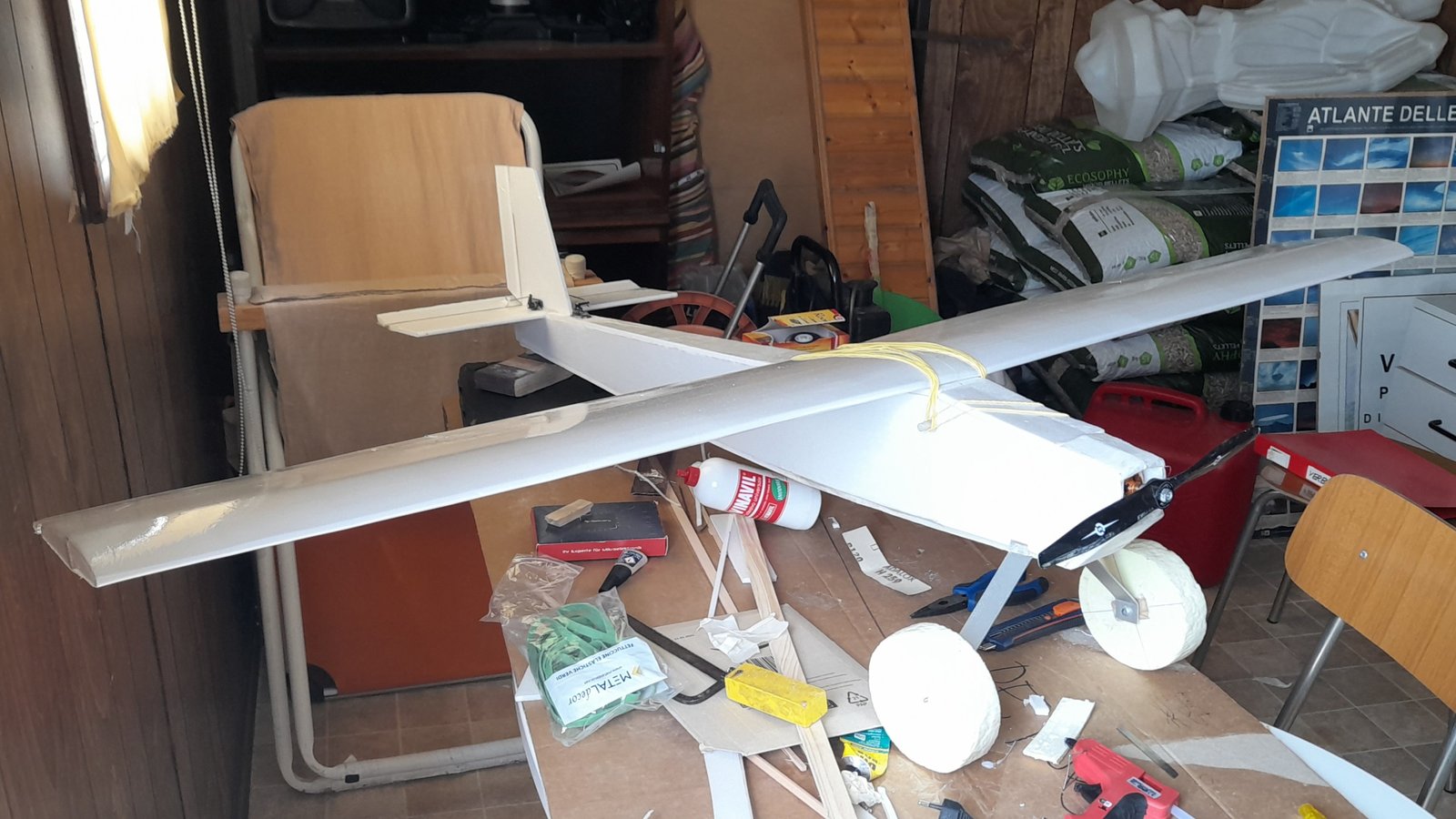
In mid May the plane was almost finished but a big flooding prevented us from reaching the field, also due to the muddy clay still covering the runway we had to replace the standard wheels with a pair of much bigger custom made foam ones in order to prevent the plane from sinking in the ground, but the exam period started right after that and this further delayed the first flight. Finally on June 26 the FCP1 (Flight Club Project 1) took off for the first time. In spite of the huge drag due to the wheels and the poorly optimized aerodynamics it was fast, controllable, easy to take-off and land. Overall quite a pleasure to fly.
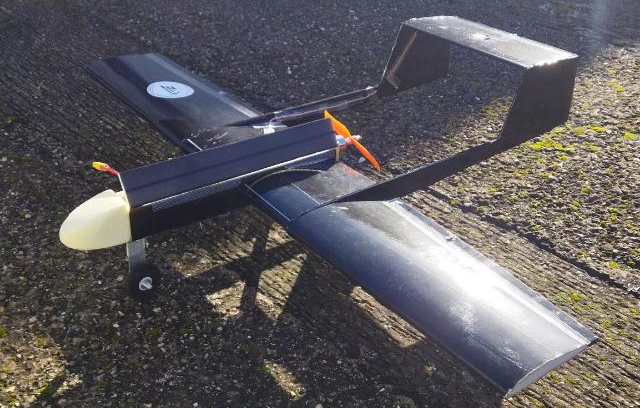
After this success we attempted to candidate for the ACC but, due to some misunderstandings and disagreement with the university we ended up missing the registration windows again and in fact it would have taken more than a year to finally start a proper technical team with academic acknowledgment (And in a perfect “Tartar Steppe” fashion, also a bit too late for me to actively take part to it). However, we didn’t despair and rather than waiting we quickly figured out that the most important part would have been to not lose the acquired skills and knowledge. So we started over the Flight Club, this time with more time available and more skilled people. We introduced new design tools, like panel method aerodynamic evaluations, MATLAB flight simulations and CAD design, blending progressively the classical aero modelling into actual engineering and slowly closing the gap between a casual form of entertainment and actual competition practice. We ended up with another finished prototype and another successful test flight.
Looking back, I believe that the most important lesson I learnt from that experience is that rather than focusing on what is missing for a certain goal to be reached, sometimes it is just better to aim for the best that can be reached with what you have available at that point, begin from that, acknowledge limits and potentials and then move on to a further step, without fearing being too slow or missing the target.