

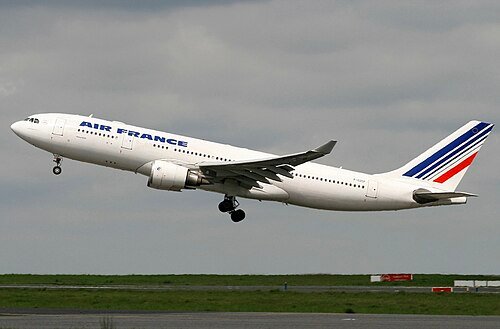

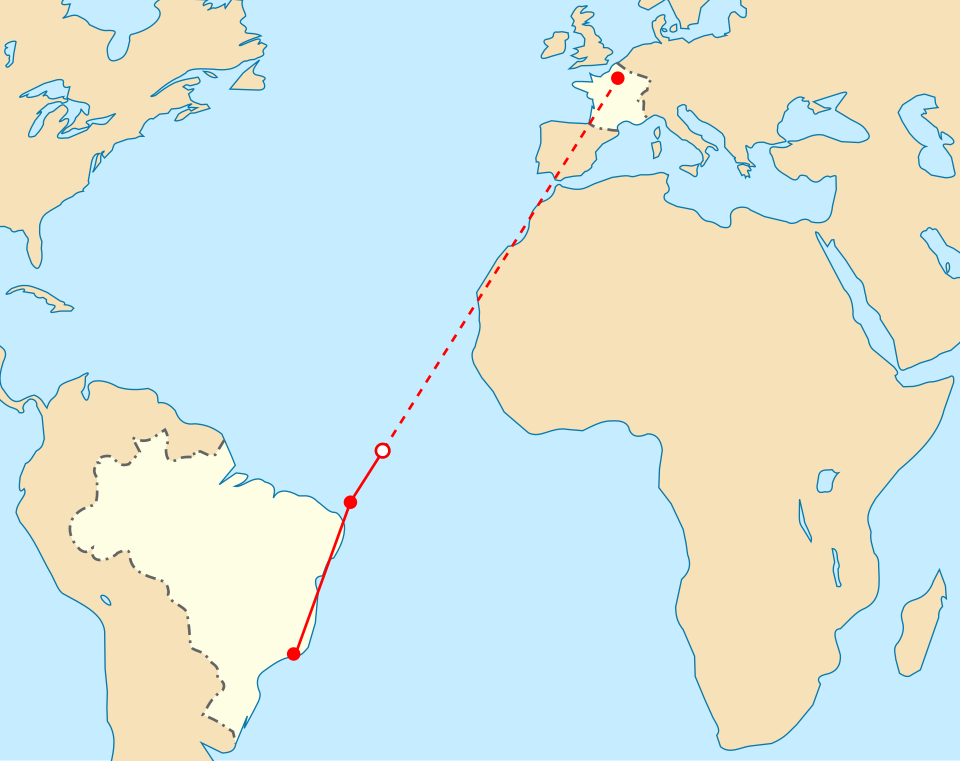
On June 1, 2009, Air France flight AF447, an Airbus A330-200 passenger plane, took off from Rio de Janeiro en route to Paris and disappeared over international airspace in the Atlantic Ocean while outside radar coverage. There were no survivors among the 216 passengers and 12 crew members on board. The subsequent search and investigation process has been recorded as one of the most extensive and costly technical investigations in the history of civil aviation.
Search Operations and Wreckage Location
In the investigation conducted by the French Civil Aviation Safety Investigation and Analysis Bureau (BEA – Bureau d’Enquêtes et d’Analyses), the main wreckage could not initially be located due to the depth and geographical conditions at the crash site. The area, where the seabed depth reaches 3,900 meters in some places, was scanned with oceanographic equipment and autonomous underwater vehicles (AUVs).
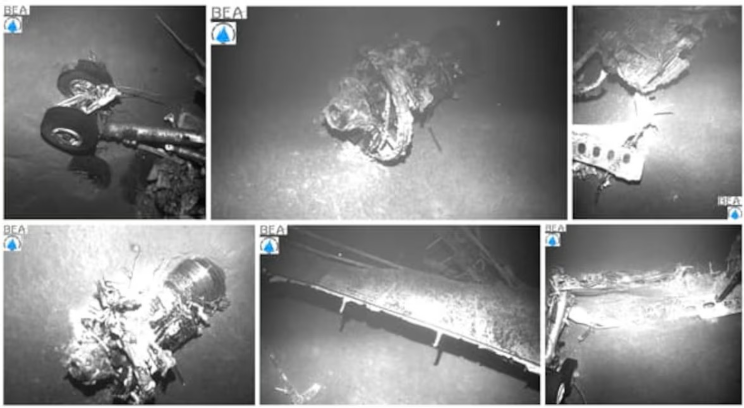
Parts of the Airbus A330 wreckage were spotted at a depth of approximately 3,900 meters by autonomous underwater vehicles (AUVs) during search operations.
Approximately 23 months after the accident, during the fourth search phase in April 2011, the main parts of the aircraft fuselage and the black boxes (Flight Data Recorder – FDR and Cockpit Voice Recorder – CVR) were recovered.
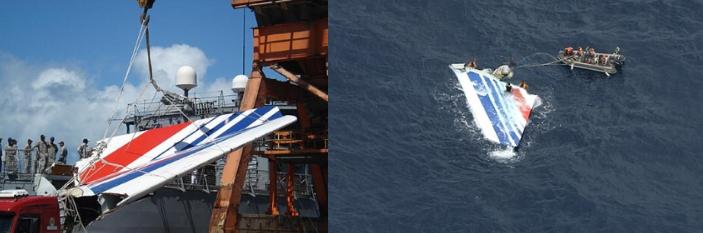
The vertical stabilizer (tail section) of the aircraft was found floating on the surface of the Atlantic Ocean days after the accident and recovered from the water.
Investigation Findings and the Chain of Accident
BEA’s final report revealed that the disaster was not caused by a single technical failure, but rather by a chain of events and human decisions in a moment of crisis. The process began with high-altitude crystal icing clogging the aircraft’s Pitot tubes (speed sensors). The sudden appearance of inaccurate speed data on the instruments caused the aircraft’s control computers to disable the autopilot system for safety reasons, handing control over to the cockpit. The co-pilot’s decision to raise the nose of the aircraft pushed the process to an irreversible point. With its nose raised, the giant Airbus A330 completely lost speed while attempting to climb and entered a “stall” state, where aerodynamic lift ceased.
Despite warning sounds echoing in the cockpit, the crew failed to diagnose the loss of lift.
With its nose in the air but its fuselage rapidly sinking vertically, the aircraft crashed into the ocean surface after approximately 3.5 minutes of freefall.
A map showing the route of Air France Flight 447.
Following the publication of the report, international aviation authorities (FAA and EASA) made radical changes to safety standards. First, Upset Prevention and Recovery Training (UPRT) simulations, covering manual control use at high altitude and procedures for exiting a stall, were made mandatory in commercial pilot training curricula.
On the other hand, Thales-manufactured Pitot tubes, which were found to be sensitive to icing, were replaced with more resistant models. The 2-year delay in recovering the black boxes from the ocean floor led to the creation of GADSS (Global Flight Tracking System) standards, which enable the real-time transmission of flight data to a centre via satellites in emergencies.
Conclusion
The Air France 447 crash has become a landmark accident case demonstrating how a single sensor temporarily losing its function due to adverse weather conditions, combined with automation system failures and subsequent human error, can lead to a catastrophe of immense magnitude. The steps taken in light of the data recovered from a depth of 3,900 meters have initiated a lasting transformation in civil aviation safety by restructuring pilot training standards, automation architectures, and global flight tracking protocols.
References
- BEA. (2012). Final Report on the Accident on 1st June 2009 to Airbus A330-203 F-GZCP (AF447).
- Bottyan, Z. (2010). Flight Path of AF447 During the Last 2 Hours. ResearchGate.
- CBC News & BEA. (2011). Robot Sub Shows Air France Crash Debris.
- EASA. (2010). SIB 2010-33: Pitot-Static System Maintenance and Operational Implications.
- ICAO. (2014). Manual on the Global Aeronautical Distress and Safety System (GADSS) (Doc 10054).
- AP & ESRI. (2009). Air France Flight 447 Flight Path and Search Area. AP News Archive.
- Agência Brasil & FAB. (2009). Air France Flight 447 Vertical Stabiliser Recovery. Wikimedia Commons.
- Cieplak, P. (2009). Air France Airbus A330-203 (F-GZCP) at Paris-CDG. Wikimedia Commons.
- Marine nationale & BEA. (2011). Deep Sea Wreckage and Search Operations at 3,900m Depth. BEA Media Library.